(Unless otherwise stated, the copyright of the materials included belong to Jan Woreczko & Wadi.)
Fragenstein
Z Wiki.Meteoritica.pl
m (→Lokalizacja) |
(→Europejski Gibeon, bo nie Muonionalusta) |
||
| Linia 48: | Linia 48: | ||
'''Specimens''': (M. Patzek, ''IfP'') Main mass (3743 g) with anonymous finder. 33 g at ''IfP'' (type specimen). | '''Specimens''': (M. Patzek, ''IfP'') Main mass (3743 g) with anonymous finder. 33 g at ''IfP'' (type specimen). | ||
| + | {{BQuote-end}} | ||
| + | |||
| + | |||
| + | === Wątpliwości?! === | ||
| + | |||
| + | Post Global Meteorite Association, Inc. relacjonujący prezentację meteorytu podczas ''Munich Show 2026'' i wybrane komentarze poddające w wątpliwość wiarygodność znaleziska: | ||
| + | {{BQuote-begin |max-width=800px}} | ||
| + | '''Meteorites, Tektites, Impactites & Ephemera'''<br /> | ||
| + | :{{Link-FB|l|groups/MTIEgroup/permalink/28446488475047678|text=Global Meteorite Association, Inc. · 28 października 2026 o 10:27}}<br /> | ||
| + | |||
| + | FRAGENSTEIN...the latest Austrian find. This incredible find was made by an Austrian hiker in a riverbed. Thinking it looked " out of place" due to its shiny appearance the hiker took it with him and offered it for research wondering it could be some kind of meteorite. After analysis it was found being similar to Muoniolusta{{MBD-record|name=Muonionalusta}} but with a big difference...Muo has a terrestrial age of around 1myo and this find had a terrestrial age of only a few thousand years.....hence no hoax but a true new Austrian meteorite. I had the luck of seeing it in person at the Munich show. | ||
| + | |||
| + | {{Wielokropek}} | ||
| + | |||
| + | :'''Sean Mahoney'''<br> | ||
| + | :The fact that it had weathered to a polished surface with zero rust and has continued in this way since it's discovery in a far-from-dry environment makes this piece stand out from most other iron meteorites that I'm aware of, and certainly from Muonionalusta. | ||
| + | |||
| + | ::'''Zsolt Kereszty'''<br> | ||
| + | ::'''Sean Mahoney''' If this was in a riverbed, it shouldn't look like this. I see zero weathering on the surface. But maybe you're right—in any case, this meteorite looks suspicious to me. | ||
| + | |||
| + | ::'''Sean Mahoney'''<br> | ||
| + | ::'''Zsolt Kereszty''' My understanding is that it was found on a trail in a river-valley, but I was busy at the show and didn't have time to fully read up on it. I agree that it is very unusual and a stretch to believe at first because as an iron it is immaculate in its unworked state. But this was being presented at the show by an institute with research data, not a private owner or dealer. It didn't look like a cleaned up Muonio in my opinion (I have cleaned a lot of Muonios and this was somehow different), but that's only based on my experience. But 100% I agree that it is difficult to believe. I look forward to finding out more about it. | ||
| + | |||
| + | ::'''Graham Ensor'''<br> | ||
| + | ::'''Sean Mahoney''' It’s obviously a meteorite and the scientific institute is not being questioned. It’s the story behind the find that is hard to believe. There are others which have gone trough this same process and published/shown but later are questionable. My thoughts are that a further weathering study would be in order to show that it could sit outside for an extended period and not rust using a small piece from the classification sample. Seems an obvious thing to do. If it then does not rust then further study needs to follow that. Then the other question is why the widmanstatten shows…which is rare…but can happen on a fresh fall through the magnetite surface. I have such a sample but that then has to match the minerals in the makeup of the meteorite for that to happen. Certainly is an interesting “new” meteorite to follow though. | ||
| + | |||
| + | {{Wielokropek}} | ||
| + | |||
| + | :'''Graham Ensor'''<br> | ||
| + | :Does seem very strange to me that it was found in a wet environment looking shiney like that. My initial thoughts would be that it is cleaned iron that has been "planted". Even a high nickel content meteorite in that environment would have a rusty weathered exterior I would have thought. | ||
| + | |||
| + | :'''Graham Ensor'''<br> | ||
| + | :Yes...if it had a magnetite crust or remnants of that then could have been a very recent fall but as soon as that crust come off it would have had a rusty surface very quickly. At best I would say it's then been cleaned subsequently but then why would the finder say it caught their eye because it was shiney at the find location? The whole thing mistifies me unless I'm missing something here? | ||
| + | |||
| + | ::'''Tomasz Jakubowski''' | ||
| + | ::'''Graham Ensor''' I ques good example is a Seymchan{{MBD-record|name=Seymchan}} meteorite found in a wet environment, in a river valley, with water in deposit.. So we can compare a not cleaned Seymchans with this specimen above... | ||
| + | |||
| + | ::'''Zsolt Kereszty'''<br> | ||
| + | ::'''Tomasz Jakubowski''' Exactly, Tomasz. And the intact surface of Seymchan specimens is never shiny! | ||
| + | |||
| + | {{Wielokropek}} | ||
| + | |||
| + | :'''Global Meteorite Association, Inc.'''<br> | ||
| + | :'''Graham Ensor''' This is Sean writing. This is my opinion, not the GMAs, but as a mod in the group it attributed it to the GMA. This meteorite is very strange indeed and there is no question that this one is very hard to believe. But I have seen a shit-tonne of sandblasted and otherwise cleaned up Muonios and this one was as clean as a whistle but didn't conform to any other complete strip-clean methods that I have seen utilized in the past. It also just didn't feel like it was a Muonio based on my experience. Whilst there was visible crystallization on the outside, most of the surface didn't reveal the internal crystal structure, and the surface appeared to be heavily worn rather than sandblasted. If it is a plant then it would almost definitely have to be from the finder because it was found in a pretty remote place, at least this is how they explained it to me. I suppose an interesting note is that since it was found there has been absolutely no oxidation either, and whilst it has obviously been looked after in a much healthier environment, that part of the world is far from dry, and untreated Munionalista will show rust spots after a few months in pretty much every case that I've known. This is why we find treatments that can overcome these issues. If it were a Muonio, the hunting community up there is pretty tight so there would be a high chance that it would be either recognized or at least some suspicions would be raised if it was run through the hunters WhatsApp groups. But this would just be being devils advocate because I genuinely believe this one is a bit too weird to be Muonio. I am really interested to see where further research goes on this piece. | ||
| + | |||
| + | ::'''Zsolt Kereszty'''<br> | ||
| + | ::'''Global Meteorite Association, Inc.''' sandblasting and after wirebrush... | ||
| + | |||
| + | ::'''Graham Ensor'''<br> | ||
| + | ::'''Zsolt Kereszty''' and possibly some acid? | ||
| + | |||
| + | ::'''Graham Ensor'''<br> | ||
| + | ::'''Global Meteorite Association, Inc.''' I would doubt mouon too. It does look much more like a much more recent fall that has had minimum weathering but still does not explain why it was not rusty. By “plant” I mean not from the location it was found. Perhaps I’m questioning the finders story but there have been many “new” meteorites where that has had to be done. I have many cleaned meteorites that have stayed without rust for many years when indoors. Something does not add up unless some analysis can show a reason why it did not rust when left out in the wet. As mentioned by another, Seymchan is a very stable meteorite but finds are always rusty initially. | ||
| + | |||
| + | {{Wielokropek}} | ||
| + | |||
| + | :'''Andries Goedhart'''<br> | ||
| + | :Dieter Heinlein and Karl Wimmer, both highly respected in the community, were involved in the research of this specimen. In my modest opinion it is legit. | ||
| + | |||
| + | ::'''Graham Ensor'''<br> | ||
| + | ::'''Andries Goedhart''' happy if they have found an explanation as to why it was not rusty. Always something to learn? | ||
| + | |||
| + | {{Wielokropek}} | ||
| + | |||
{{BQuote-end}} | {{BQuote-end}} | ||
Wersja z 23:43, 11 lis 2026
 |
Strona w budowie (Site under construction) Jeszcze to chwilę potrwa (It will take a while) |
Europejski Gibeon, bo nie Muonionalusta
| Fragenstein → | |

Meteoryt Fragenstein (źródło: Universität Innsbruck)
| |
| Znalezisko | |
| Lokalizacja | Tirol, Austria |
| Położenie[1] | 47°17'20"N, 11°14'12"E |
| Data | 5 września 2020 r. |
| Charakterystyka | |
| Typ | meteoryt żelazny IVA, oktaedryt drobnoziarnisty (Of, fine octahedrite) |
| Masa | ~3,820 kg |
| Liczba okazów | jeden okaz |
| Cechy | niski stopień zwietrzenia |
| Meteoritical Bulletin Database | |
Znaleziony 5 września 2020 roku przez anonimową osobę wspinającą się w korycie potoku Schlossbach w Tyrolu w Alpach Austriackich, w okolicy miejscowości Zirl, niedaleko ruin zamku Fragenstein, powyżej obecnej linii wody. Znalazca zwrócił na niego uwagę ze względu na metaliczny wygląd. Na powierzchni widoczne były ślady struktury Widmanstättena, uwidocznione w wyniku procesów wietrzenia na Ziemi.
Jeden okaz (o wadze około 3820 g), bez widocznej skorupy obtopieniowej, o gęstości 7,875±0,009 g/cm³, określonej na podstawie skanowania 3D. Powierzchnia zewnętrzna jest lekko wygładzona, a struktura Widmanstättena jest słabo widoczna. Całkowity brak skorupy obtopieniowej lub warstwy tlenków wskazuje na ciągłą erozję zewnętrznych części meteorytu w wyniku przemieszczania się i mechanicznego ścierania. Na wytrawionej powierzchni przekroju widoczna jest struktura Widmanstättena z lamelami kamacytu o szerokości 0,31±0,1 mm. W zagłębieniach na zewnętrznej powierzchni meteorytu znajdują się czarne pozostałości, które mogą być fragmentami skorupy obtopieniowej.
Podobieństwo składu chemicznego do meteorytu Muonionalusta[2] skłoniło badaczy do przeprowadzenia szczegółowych analiz radionuklidów kosmogenicznych.[3] Wszystkie zmierzone stosunki izotopowe oraz wynikające z nich aktywności właściwe są około tysiąc razy wyższe niż poziomy aktywności zmierzone w próbce meteorytu żelaznego o bardzo podobnym składzie chemicznym, czyli Muonionalusta. Wysokie aktywności 36Cl i 41Ca w meteorycie Fragenstein wykluczają długi wiek ziemski.[4] Pomimo bardzo podobnego składu chemicznego meteorytów Fragenstein i Muonionalusta stężenia radionuklidów kosmogenicznych w Fragenstein wyraźnie wskazują, że meteoryty te spadły w różnych okresach, mimo znacznego podobieństwa chemicznego.
Wszystkie informacje, jakie posiadamy o tym meteorycie, pochodzą ze zgłoszenia w Meteoritical Bulletin Database i z kilku artykułów prasowych. Nie ukazała się jeszcze żadna publikacja o nim. Na portalu YouTube uniwersytet w Innsbruku zamieścił dwa filmy z omówieniem wyników badań okazu. Ale nadal nie znamy, np. wyników pomiarów jego wieku ziemskiego.
- Opis w Meteoritical Bulletin Database

Fragenstein 47.28893°N, 11.23669°E
- Tirol, Austria
- Find: 2020 Sep 5
- Classification: Iron meteorite (IVA)
History: (M. Patzek, IfP) Found on 5 September 2020 by an anonymous person who was climbing in a stream bed in the Austrian Alps in the wider area of Zirl, above the current water line. The finder noted it due to the metallic appearance. The surface showed evidence of a Widmanstätten pattern, made visible by terrestrial alteration.
Physical characteristics: (M. Patzek, IfP) One individual (~3820 g) without visible fusion crust with a density of 7.875±0.009 g/cm³ determined by 3D scanning. Slightly polished exterior with vague visible Widmanstätten pattern, due to different resistance to weathering of taenite and kamacite. The overall absence of fusion crust or oxide layer indicates continuous erosion of the outer parts of the meteorite by movement and mechanical abrasion. Etched cut face shows Widmanstätten pattern with <0.5 mm wide kamacite lamellae. Depressions on the outer part of the meteorite contain black remnants of a possible fusion crust.
Petrography: (M. Patzek, IfP) Kamacite lamellae have a mean width of 0.31±.1 mm (range from 0.19 to 0.48: n=23).
Geochemistry: Mineral compositions and geochemistry: (M. Patzek, IfP) Trace Element[5] concentrations have been determined by LA-ICP-MS.[6] A Muonionalusta[2] sample was used as an internal unknown sample to verify the accuracy of the analyses (G. Papola, F. Wombacher, M. Fischer-Gödde, Köln). 1 RSD% of the element data is given in brackets: Fe 90.77 wt% (0.5%), Ni 8.85 wt% (4%), Co 3814 ppm (2.5%), Cu 100 ppm (15%), Ga 2.07 ppm (7%), Mo 7.29 ppm (10%), Os 1.04 ppm (10%), Ir 1.08 ppm (10%), Ru 2.72 ppm (8%), Pt 4.27 ppm (10%), Rh 0.77 ppm (6%), Pd 7.6 ppm (6%), Au 2.03 ppm (5%). The chemical similarities with Muonionalusta motivated a detailed analyses of cosmogenic radionuclides. Cosmic ray exposure: A small aliquot sample (~88 mg) of the Fragenstein specimen was analyzed for several cosmogenic radionuclides (10Be, 26Al, 36Cl, and 41Ca) at the VERA facility, UVien. All measured isotopic ratios and resulting specific radioactivities from ~3.5 dpm/kg 26Al to ~21 dpm/kg 36Cl are about three orders of magnitude higher than radioactivity levels for a sample from an iron meteorite of very similar chemical composition, i.e., Muonionalusta. The high levels of 36Cl and 41Ca (~17 dpm/kg) of Fragenstein preclude a long terrestrial age.[4]
Classification: (M. Patzek, IfP) Iron, IVA, based on trace element abundances, petrography and mineral chemistry. Fine octahedrite. Despite the very similar composition of Fragenstein and Muonionalusta, the cosmogenic radionuclide concentrations of Fragenstein clearly show that they fell in separate events despite being chemically very similar.
Specimens: (M. Patzek, IfP) Main mass (3743 g) with anonymous finder. 33 g at IfP (type specimen).

Wątpliwości?!
Post Global Meteorite Association, Inc. relacjonujący prezentację meteorytu podczas Munich Show 2026 i wybrane komentarze poddające w wątpliwość wiarygodność znaleziska:
Meteorites, Tektites, Impactites & Ephemera
FRAGENSTEIN...the latest Austrian find. This incredible find was made by an Austrian hiker in a riverbed. Thinking it looked " out of place" due to its shiny appearance the hiker took it with him and offered it for research wondering it could be some kind of meteorite. After analysis it was found being similar to Muoniolusta[2] but with a big difference...Muo has a terrestrial age of around 1myo and this find had a terrestrial age of only a few thousand years.....hence no hoax but a true new Austrian meteorite. I had the luck of seeing it in person at the Munich show.
(…)
- Sean Mahoney
- The fact that it had weathered to a polished surface with zero rust and has continued in this way since it's discovery in a far-from-dry environment makes this piece stand out from most other iron meteorites that I'm aware of, and certainly from Muonionalusta.
- Zsolt Kereszty
- Sean Mahoney If this was in a riverbed, it shouldn't look like this. I see zero weathering on the surface. But maybe you're right—in any case, this meteorite looks suspicious to me.
- Zsolt Kereszty
- Sean Mahoney
- Zsolt Kereszty My understanding is that it was found on a trail in a river-valley, but I was busy at the show and didn't have time to fully read up on it. I agree that it is very unusual and a stretch to believe at first because as an iron it is immaculate in its unworked state. But this was being presented at the show by an institute with research data, not a private owner or dealer. It didn't look like a cleaned up Muonio in my opinion (I have cleaned a lot of Muonios and this was somehow different), but that's only based on my experience. But 100% I agree that it is difficult to believe. I look forward to finding out more about it.
- Sean Mahoney
- Graham Ensor
- Sean Mahoney It’s obviously a meteorite and the scientific institute is not being questioned. It’s the story behind the find that is hard to believe. There are others which have gone trough this same process and published/shown but later are questionable. My thoughts are that a further weathering study would be in order to show that it could sit outside for an extended period and not rust using a small piece from the classification sample. Seems an obvious thing to do. If it then does not rust then further study needs to follow that. Then the other question is why the widmanstatten shows…which is rare…but can happen on a fresh fall through the magnetite surface. I have such a sample but that then has to match the minerals in the makeup of the meteorite for that to happen. Certainly is an interesting “new” meteorite to follow though.
- Graham Ensor
(…)
- Graham Ensor
- Does seem very strange to me that it was found in a wet environment looking shiney like that. My initial thoughts would be that it is cleaned iron that has been "planted". Even a high nickel content meteorite in that environment would have a rusty weathered exterior I would have thought.
- Graham Ensor
- Yes...if it had a magnetite crust or remnants of that then could have been a very recent fall but as soon as that crust come off it would have had a rusty surface very quickly. At best I would say it's then been cleaned subsequently but then why would the finder say it caught their eye because it was shiney at the find location? The whole thing mistifies me unless I'm missing something here?
- Tomasz Jakubowski
- Graham Ensor I ques good example is a Seymchan[7] meteorite found in a wet environment, in a river valley, with water in deposit.. So we can compare a not cleaned Seymchans with this specimen above...
- Zsolt Kereszty
- Tomasz Jakubowski Exactly, Tomasz. And the intact surface of Seymchan specimens is never shiny!
- Zsolt Kereszty
(…)
- Global Meteorite Association, Inc.
- Graham Ensor This is Sean writing. This is my opinion, not the GMAs, but as a mod in the group it attributed it to the GMA. This meteorite is very strange indeed and there is no question that this one is very hard to believe. But I have seen a shit-tonne of sandblasted and otherwise cleaned up Muonios and this one was as clean as a whistle but didn't conform to any other complete strip-clean methods that I have seen utilized in the past. It also just didn't feel like it was a Muonio based on my experience. Whilst there was visible crystallization on the outside, most of the surface didn't reveal the internal crystal structure, and the surface appeared to be heavily worn rather than sandblasted. If it is a plant then it would almost definitely have to be from the finder because it was found in a pretty remote place, at least this is how they explained it to me. I suppose an interesting note is that since it was found there has been absolutely no oxidation either, and whilst it has obviously been looked after in a much healthier environment, that part of the world is far from dry, and untreated Munionalista will show rust spots after a few months in pretty much every case that I've known. This is why we find treatments that can overcome these issues. If it were a Muonio, the hunting community up there is pretty tight so there would be a high chance that it would be either recognized or at least some suspicions would be raised if it was run through the hunters WhatsApp groups. But this would just be being devils advocate because I genuinely believe this one is a bit too weird to be Muonio. I am really interested to see where further research goes on this piece.
- Zsolt Kereszty
- Global Meteorite Association, Inc. sandblasting and after wirebrush...
- Zsolt Kereszty
- Graham Ensor
- Zsolt Kereszty and possibly some acid?
- Graham Ensor
- Graham Ensor
- Global Meteorite Association, Inc. I would doubt mouon too. It does look much more like a much more recent fall that has had minimum weathering but still does not explain why it was not rusty. By “plant” I mean not from the location it was found. Perhaps I’m questioning the finders story but there have been many “new” meteorites where that has had to be done. I have many cleaned meteorites that have stayed without rust for many years when indoors. Something does not add up unless some analysis can show a reason why it did not rust when left out in the wet. As mentioned by another, Seymchan is a very stable meteorite but finds are always rusty initially.
- Graham Ensor
(…)
- Andries Goedhart
- Dieter Heinlein and Karl Wimmer, both highly respected in the community, were involved in the research of this specimen. In my modest opinion it is legit.
- Graham Ensor
- Andries Goedhart happy if they have found an explanation as to why it was not rusty. Always something to learn?
- Graham Ensor
(…)
Meteoryty żelazne grupy IVA
O meteorytach żelaznych grupy IVA (Woźniak 2021):
Grupa IVA
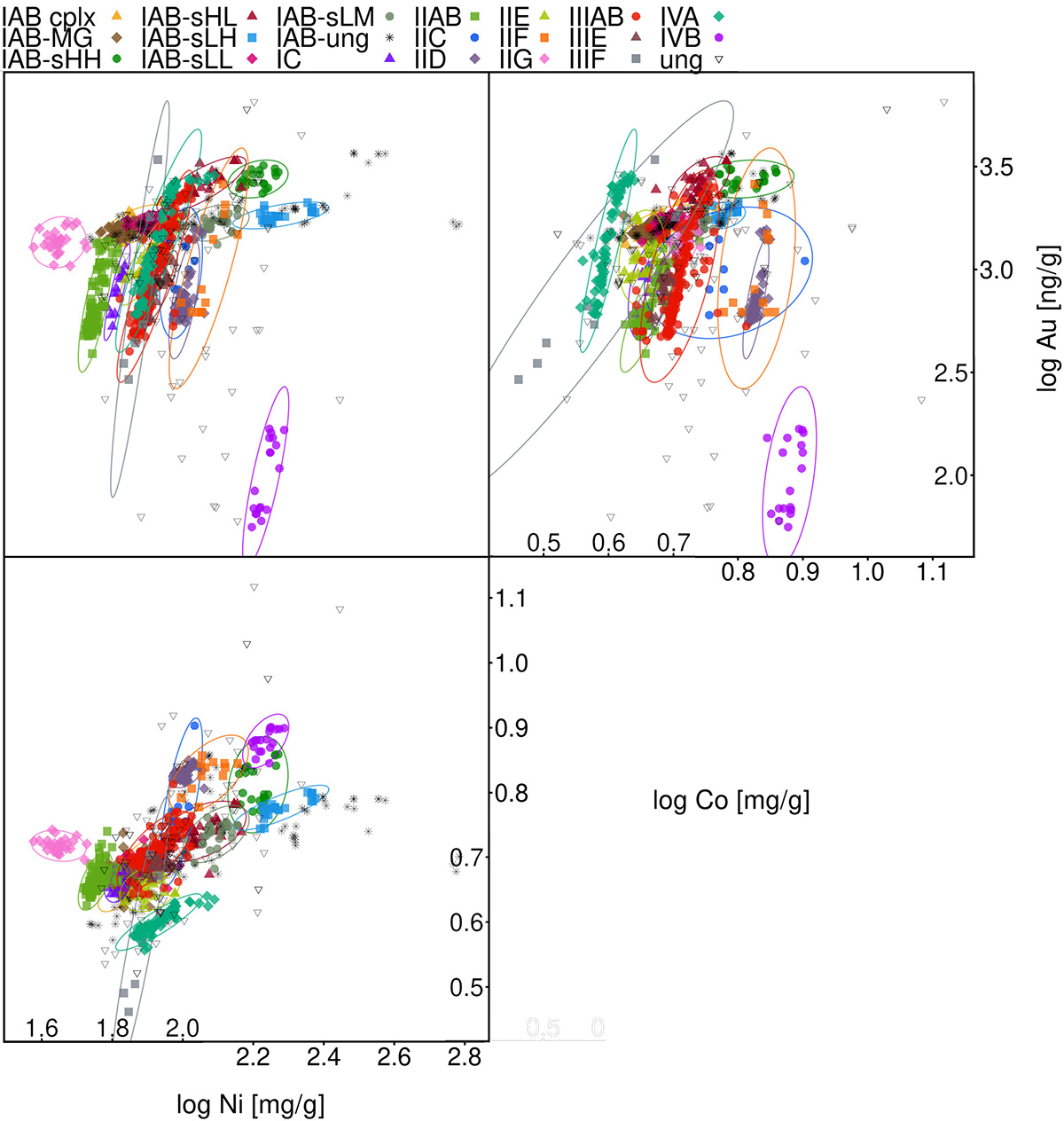
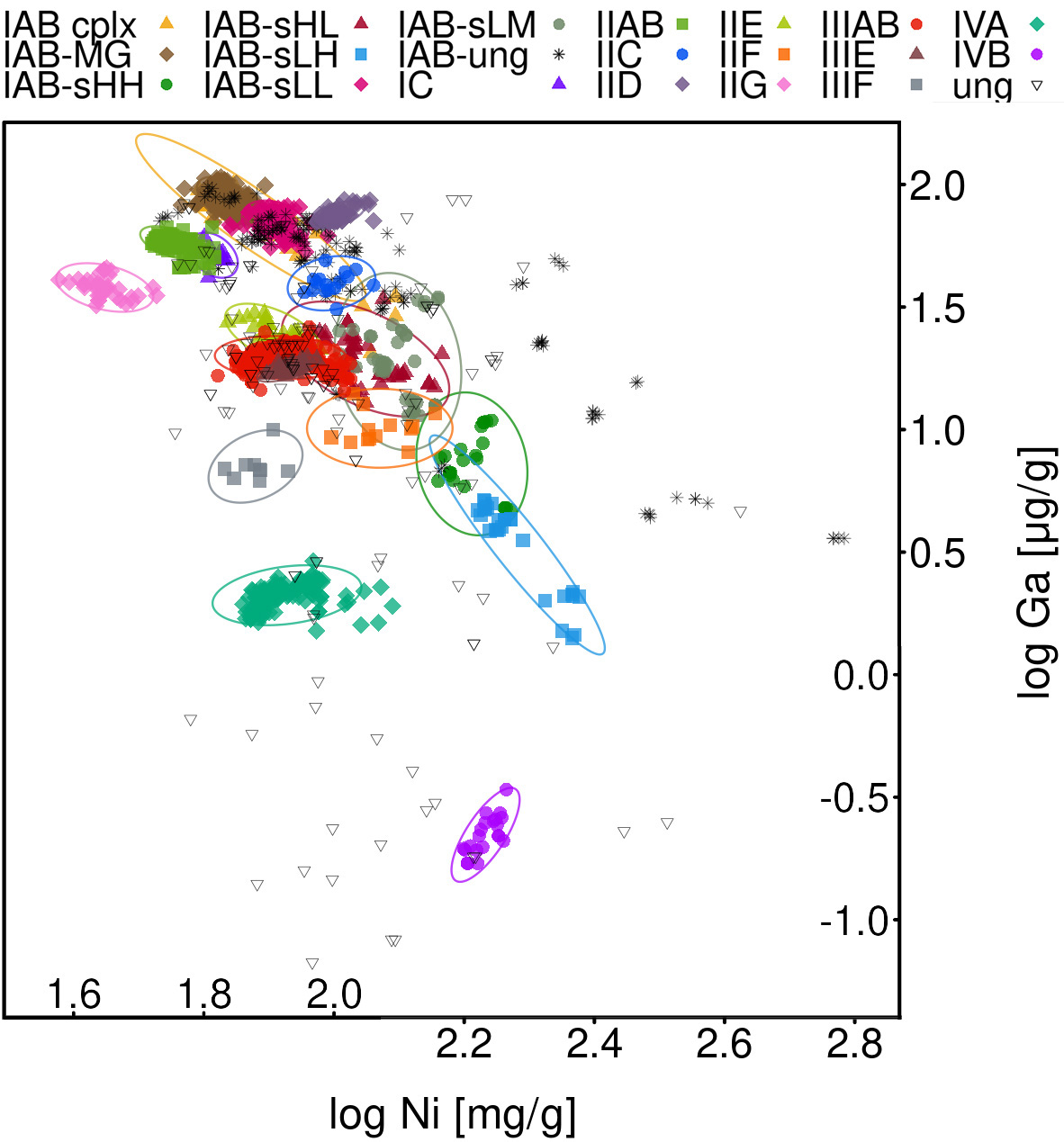
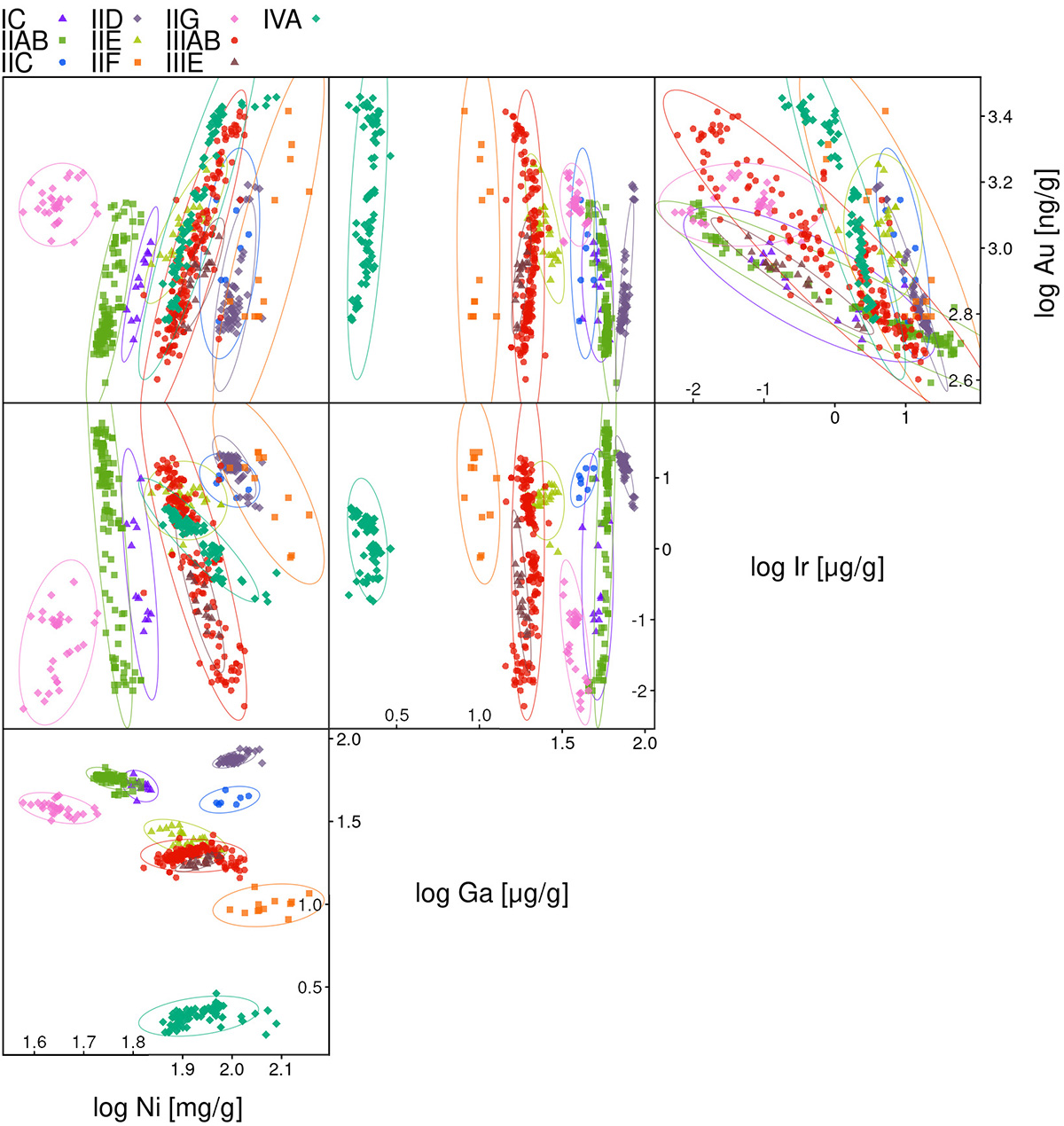
Grupa IVA – grupa o najniższej wśród meteorytów żelaznych zawartości kobaltu (Co) oraz bardzo niskiej zawartości germanu i galu (rys. 6). Zawartość niklu rzadko przekracza w nich 10% (100 ppm) (rys. 17). Wszystkie meteoryty tej grupy to oktaedryty drobnoziarniste (Of).[8] Na wykresach Ni-Ga i Ni-Ge grupa jest silnie izolowana i bardzo zwarta – wartości dla Ga i Ge są w wąskim przedziale. Zawartość galu jest w grupie IVA kilkanaście razy większa od zawartości germanu! (rys. 4) (odwrotnie niż w grupie IIF, gdzie przeważa german).
Charakterystyczny dla tej grupy jest nieznaczny wzrost szerokości belek kamacytu wraz ze wzrostem zawartości niklu (rys. 1), takiej dodatniej korelacji nie obserwuje się dla innych grup, gdzie korelacja jest ujemna! Może to sugerować, że grupa IVA składa się z dwóch podgrup pochodzących z różnych ciał macierzystych?! Na poparcie tej tezy świadczą obserwacje pewnych luk (gap) w zawartościach niklu i irydu, które mogą sugerować istnienie dwóch podgrup (rys. 15). Również modelowanie formowania się struktur Thomsona-Widmanstättena dla grupy IVA wskazują na lukę w tempie stygnięcia ciała macierzystego. Badacze skłaniają się jednak ku twierdzeniu, że sugerowany podział na dwie podgrupy to artefakt i wynika z mało reprezentatywnej liczby próbek oraz z subiektywnego i niejednoznacznego pomiaru szerokości belek kamacytu.[9] Zagadnienie otwarte. Obliczone średnie tempo stygnięcia ciała macierzystego (stopu Fe-Ni) dla tej grupy wynosi ~100-6600 stopni ma milion lat (~100-6600ºC/My). Wartość najniższe dotyczą meteorytów z grupy IVA o dużej zawartości niklu, wartości najwyższe dotyczą meteorytów tej grupy o najniższej zawartości niklu.[10] Tak duże tempo stygnięcia znajduje również swoje odzwierciedlenia w morfologii pól plessytu obserwowanych w okazach z tej grupy. Zbliżone wartości izotopów tlenu (Δ17O i δ18O) dla meteorytów grupy IVA i chondrytów zwyczajnych typu L i LL, sugerowały ich wspólne pochodzenie. Ale obecnie hipoteza ta jest odrzucana, gdyż wydaje się mało prawdopodobne by żelazo i chondryty pochodziły z tego samego ciała, które dla pierwszych było całkowicie stopione, a te drugie nie uległy znacznemu stopieniu (Scott 2020).

W składzie meteorytów grupy IVA całkowicie brak cohenitu, haxonitu, grafitu i carlsbergitu. Bardzo rzadko obserwuje się małe inkluzje krzemianów. Schreibersyt jest rzadki, a w nisko niklowych członkach grupy nieobecny. Natomiast minerał daubréelit jest bardzo obfity, i dla nisko niklowych członków, jest najczęściej liczniejszy niż troilit. Sam troilit jest popularny oraz występuje w formie nodul (Scott et al. 1975).
Opisując skład mineralny członków tej grupy trzeba pamiętać, że należą do niej również nietypowe, anomalne meteoryty Steinbach i São João Nepomuceno, które swym składem i budową przysparzają tylko „kłopotów” naukowcom! Zawierają one tak dużo krzemianów, iż należałoby je właściwie klasyfikować jako żelazno-kamienne. Jednak skład chemiczny i tekstura ich metalowych części oraz wyznaczone tempo chłodzenia ściśle odpowiadają cechom grupy IVA. Ich frakcja metaliczna ma wyraźną strukturę oktaedrytu, ale ich wtrącenia krzemianowe są zagadką. Chociaż skład izotopowy tlenu w krzemianowej fazie przypomina ten dla chondrytów zwyczajnych typu L i LL, jednak jej mineralogia jest całkowicie niechondrytowa.
W meteorycie Gibeon zaobserwowano płytki polimorficznej odmiany kwarcu trydymitu, a meteoryt Muonionalusta zawiera płytki minerału wysokociśnieniowego stiszowitu, który prawdopodobnie pierwotnie był trydymitem. W okazach grupy IVA powszechne są linie Neumanna (Scott 2020).
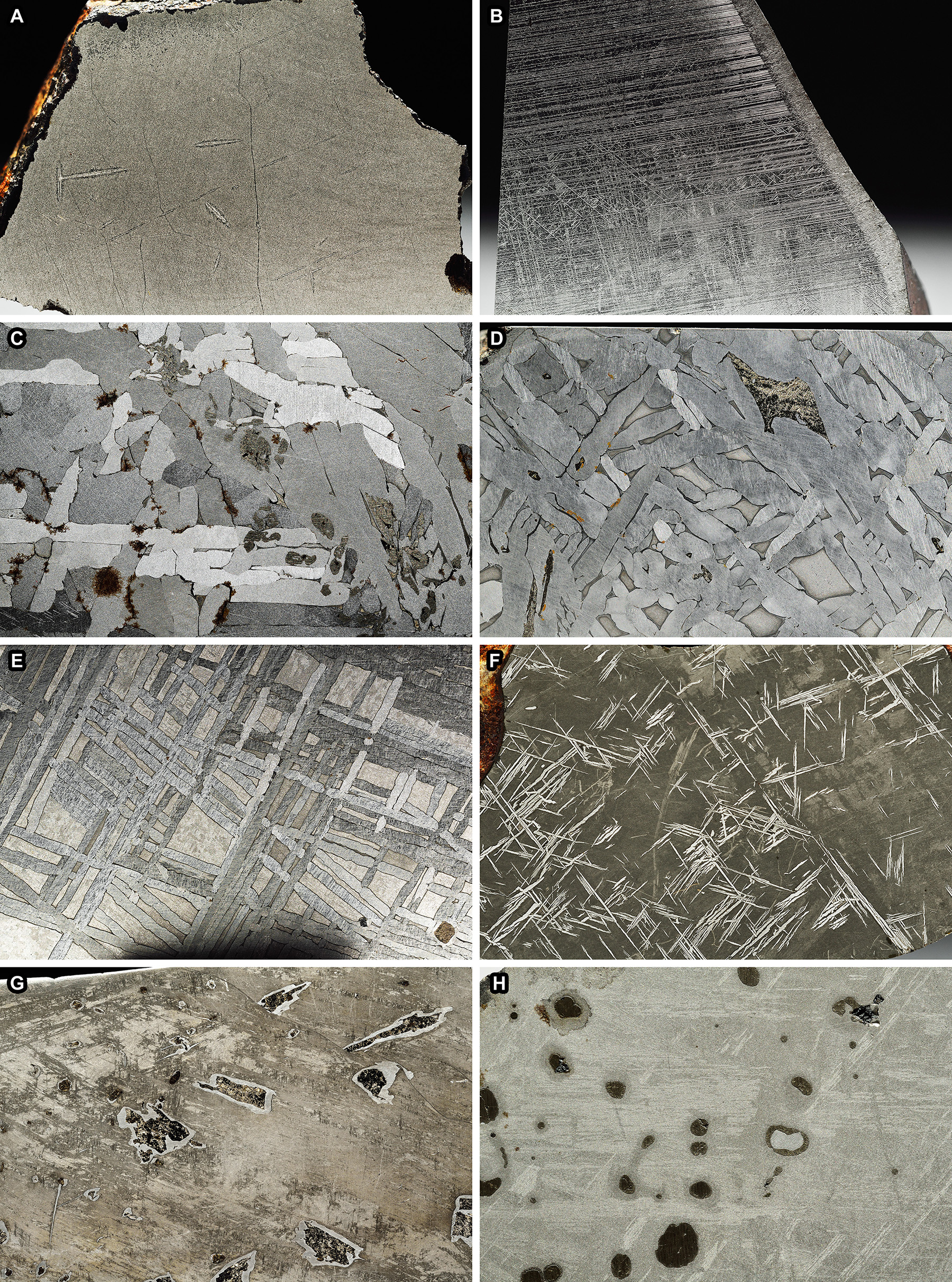
Grupa jest liczna, zajmuje czwarte miejsce pod względem liczebności po grupach IAB, IIAB i IIIAB. Najbardziej znane meteoryty tej grupy to: Gibeon[11], Muonionalusta[2], Gan Gan, Zaragoza (IVA-an) (fot. 1) oraz najnowsze europejskie znalezisko Fragenstein i nieudokumentowany Kaposfüred. Większość okazów meteorytów z tej grupy ma też bardzo ładny wzór figur Thomsona-Widmanstättena. Do grupy tej należy też już wspomniany wyjątkowej urody anomalny Steinbach (IVA-an) (fot. 7).
Lokalizacja
(Z) Zirl
Ruiny Burgruine Fragenstein
* W październiku 2026 roku Google ponownie (!) zmieniło zasady działania apletu, mapa przestała wyświetlać się poprawnie (nie wyświetlają się nasze .KML)[12]; więcej → Szablon:GEMap-MyWiki
Okaz został znaleziony w korycie potoku Schlossbach w Tyrolu, w okolicy miejscowości Zirl, niedaleko ruin zamku Fragenstein, powyżej obecnej linii wody.
Galerie
Źródło: Universität Innsbruck
 Naturalna powierzchnia zewnętrzna jest lekko wygładzona i są na niej widoczne figury Widmanstättena |
 Wytrawiony przekrój z widocznymi figurami Widmanstättena |
Meteoryt po rejestracji był prezentowany na targach Munich Show 2026
 |
 |
 |
Bibliografia
- Woźniak Marek, (2021), Meteoryty żelazne – klasyfikacja w obrazach (Iron meteorites – classification in pictures), Acta Soc. Metheor. Polon., 12, 2021, s. 149-216 (abstrakt).[13] Plik ASMP; Książka abstraktów.
Przypisy

Zobacz również
- meteoryty: Hirschbach ● Kaposfüred ● Steinbach
- meteoryt Zadzim
Linki zewnętrzne
- Meteoritical Bulletin Database (MBD) – meteoryt Fragenstein
- Encyclopedia of Meteorites (EoM) – meteoryt Fragenstein
- YouTube – Universität Innsbruck: Kurz-Clip: Meteoritenfund nahe Innsbruck ● Meteoritenfund nahe Innsbruck: der Mineraloge Jürgen Konzett der Uni Innsbruck im Gespräch
- Facebook – FRAGENSTEIN...the latest Austrian find.
- DerStandard.at – Eisenmeteorit bei Innsbruck gefunden
- Munich Show – Ein Tiroler Bachbett schreibt Meteoritengeschichte
- Universität Innsbruck – SELTENER METEORITEN-FUND IN TIROL
- Dresden University of Technology: Institute of Nuclear and Particle Physics – FROM A FIREBALL TO THE FELSENKELLER LAB: STUDENTS STUDY METEORITES
- woreczko.pl – o budowie heksaedrytów i oktaedrytów: Figury, struktury Widmanstättena (Widmanstätten pattern; Widmanstatten)